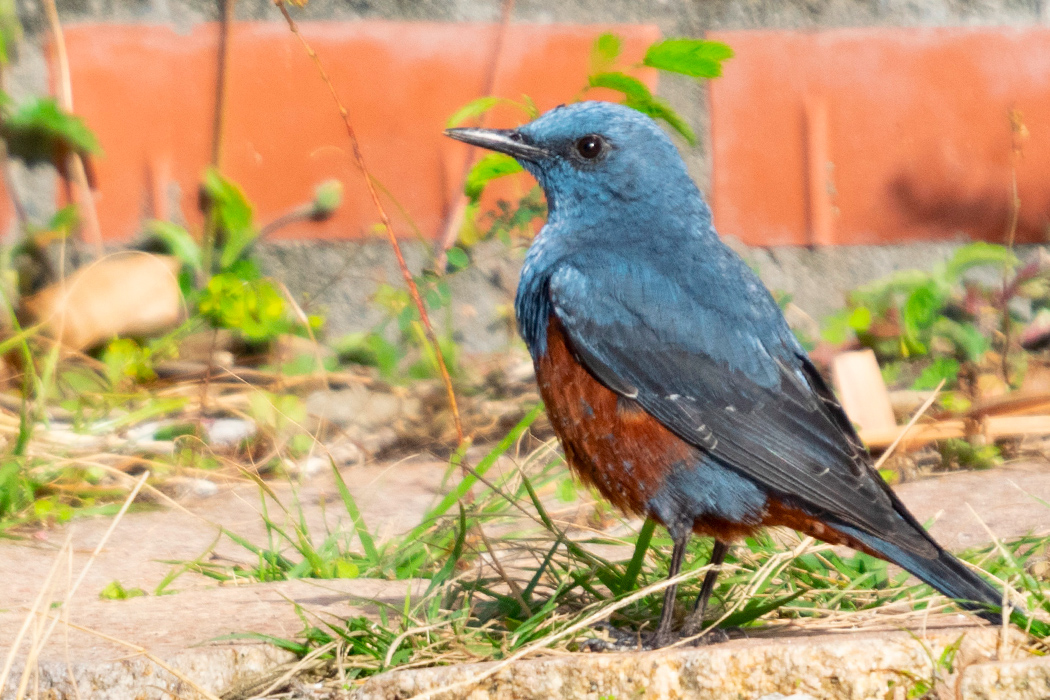
Blue Rock Thrush
Sings with a complex melody.
| Scientific name | Monticola solitarius |
| English name | Blue Rock Thrush |
| Japanese name | 磯鵯 |
| Class | Aves |
| Order | Passeriformes |
| Family | Muscicapidae |
| Genus | Monticola |
| Species | solitarius |
| Full length | Approx. 23cm |
| Distribution | Found throughout Japan, not only on coasts but also in urban areas. |
Blue Rock Thrush Characteristics and Morphology
About the size of a starling, with a plump belly.
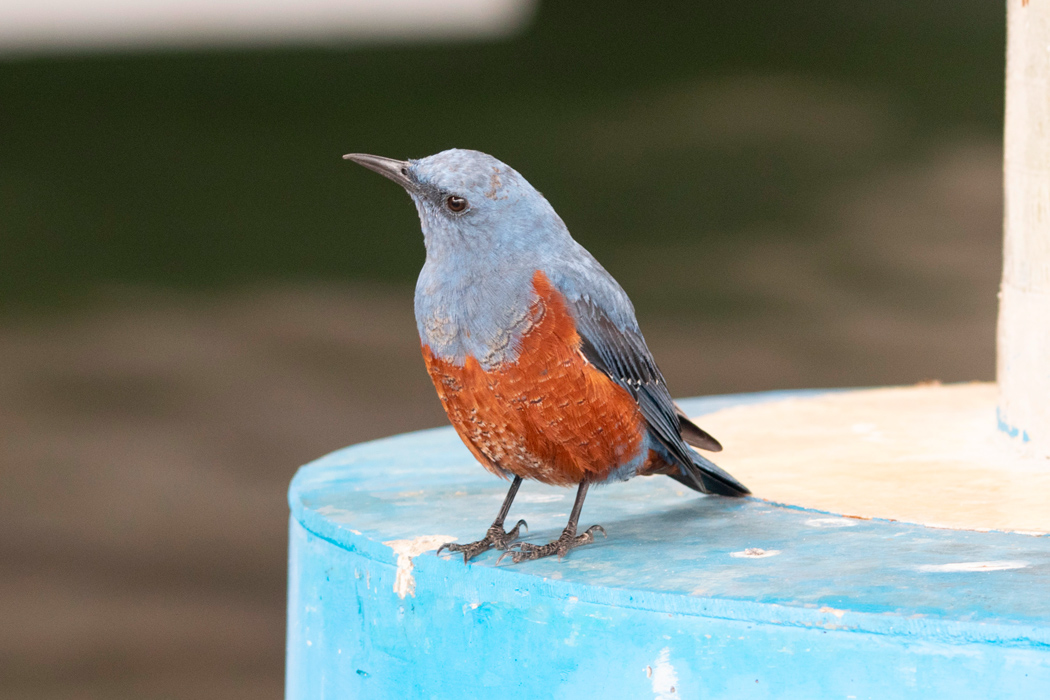
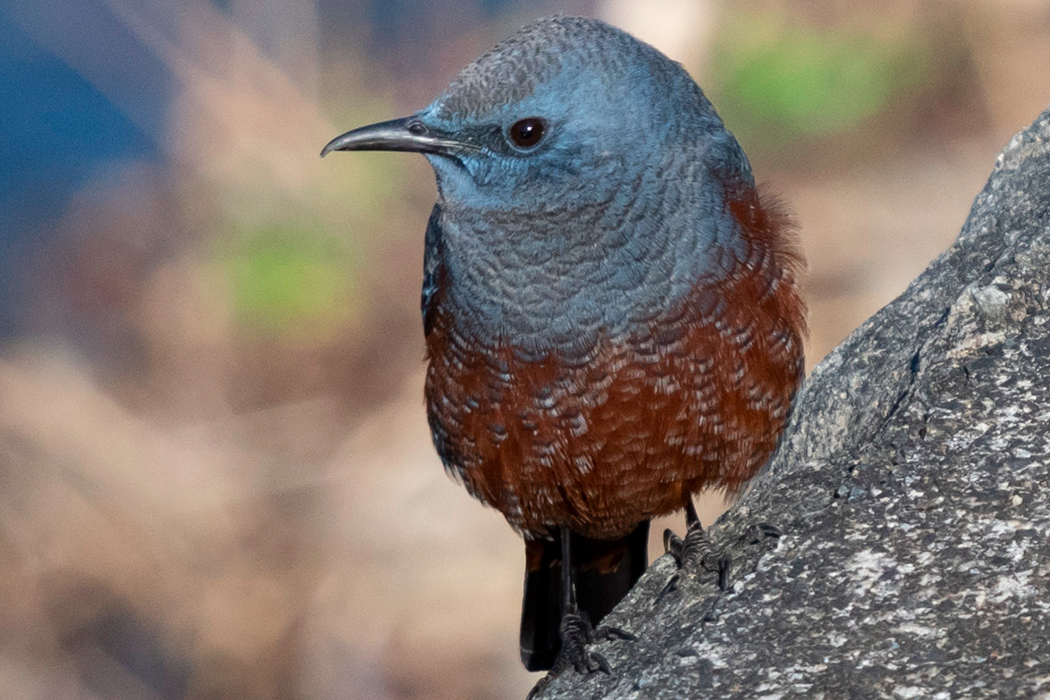
The beak is slightly longer and thinner than a starling's, with a sharp tip and lead-gray color. The iris is black.
The feather pattern is scaly, with colors becoming darker toward the wing tips.
The legs are lead-gray.
Male
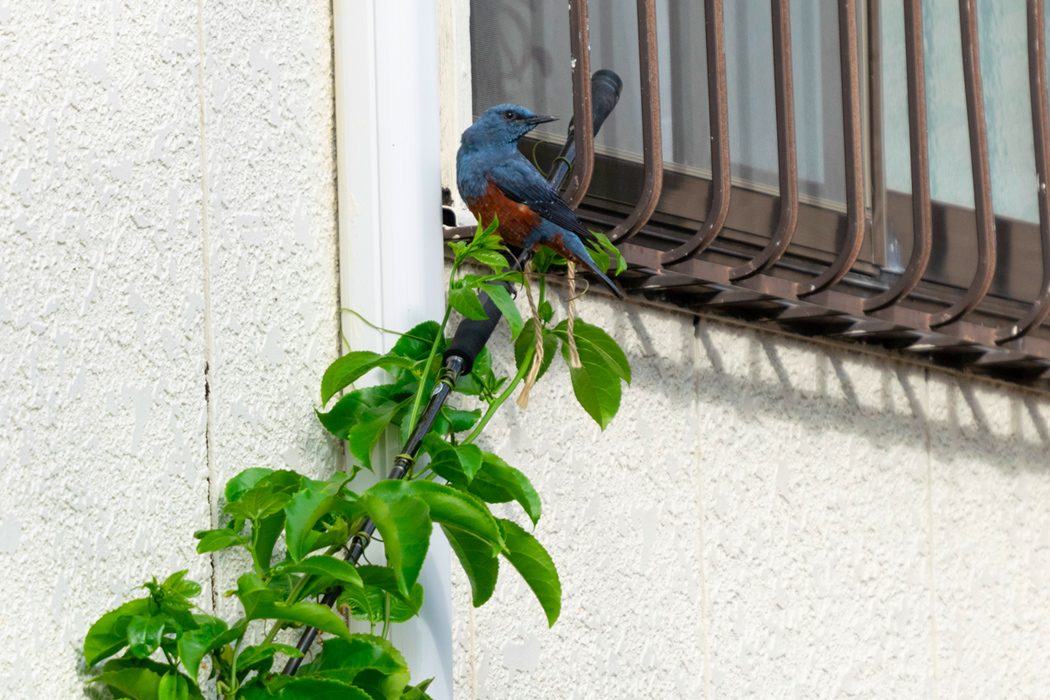
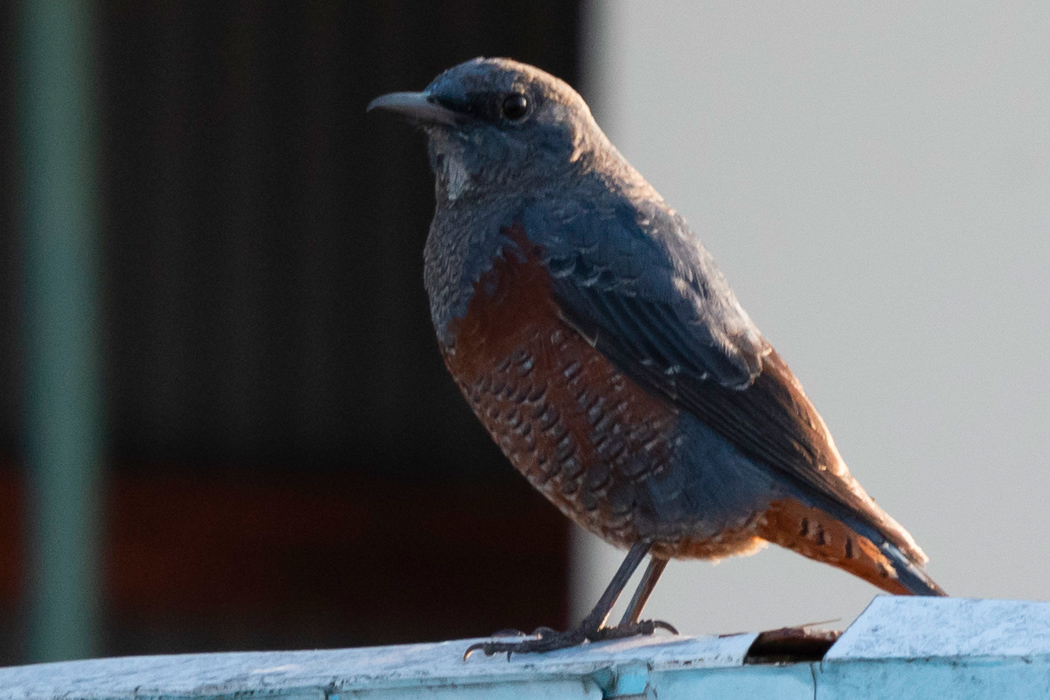
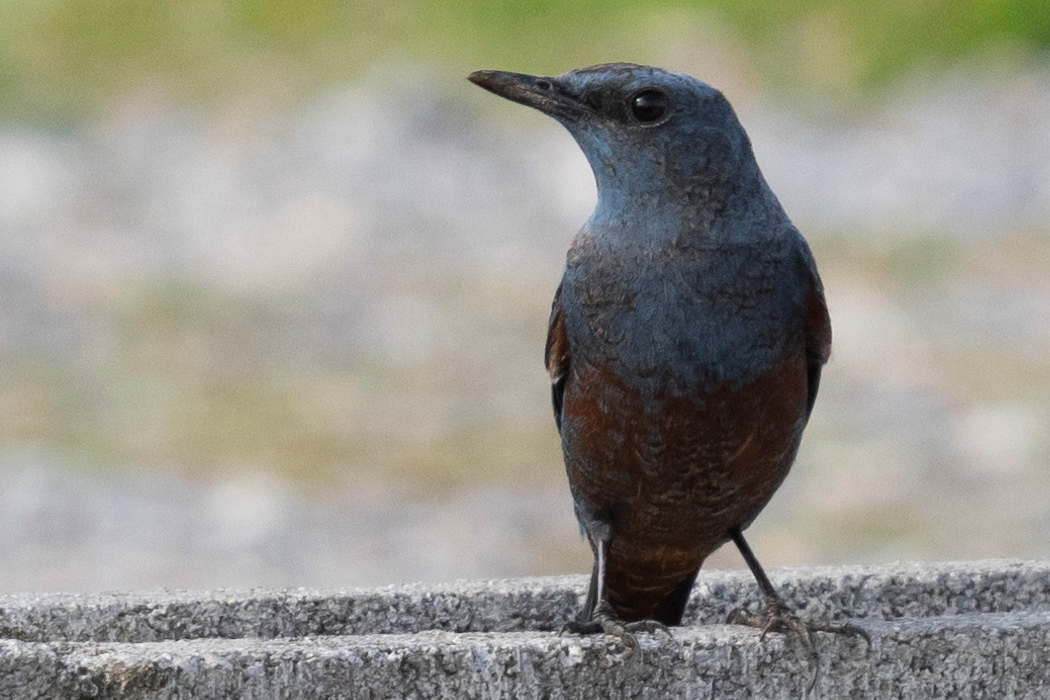
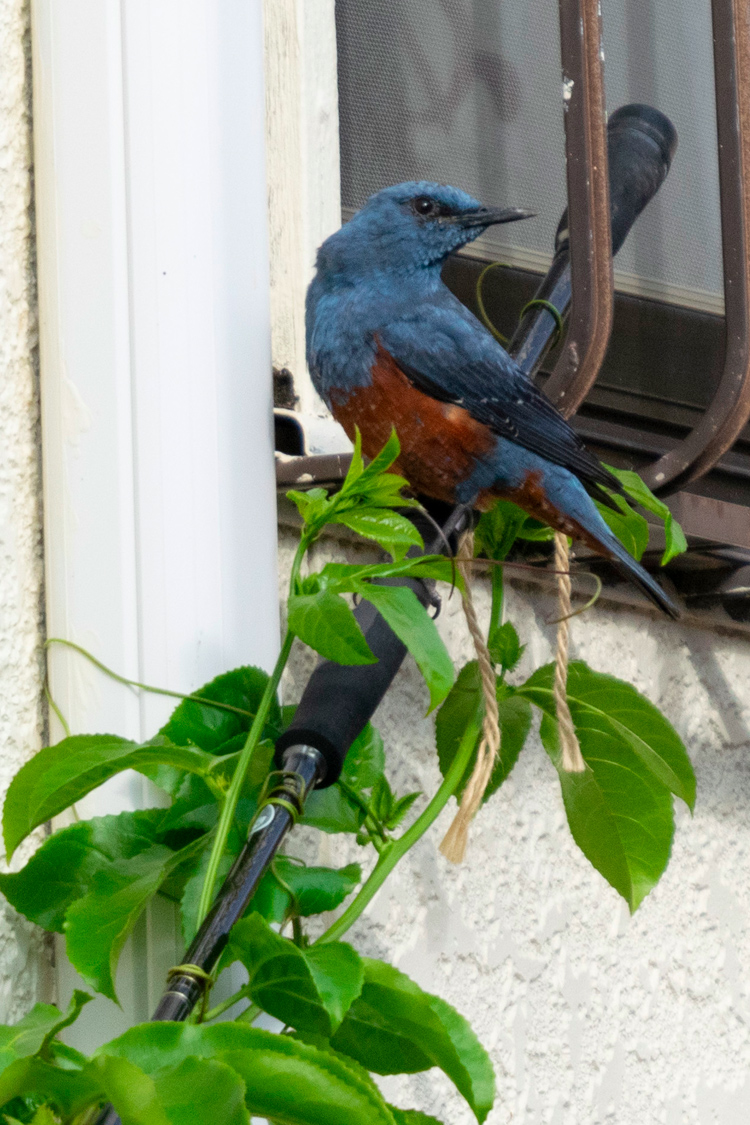
Characterized by dark blue and brick-red colors. The blue appears different depending on how the light hits it.
Dark blue from the head to the throat and chest. Mature individuals have clear boundaries between colors.
The flight feathers are nearly black. The belly is a vivid brown, colored like brick.
Female
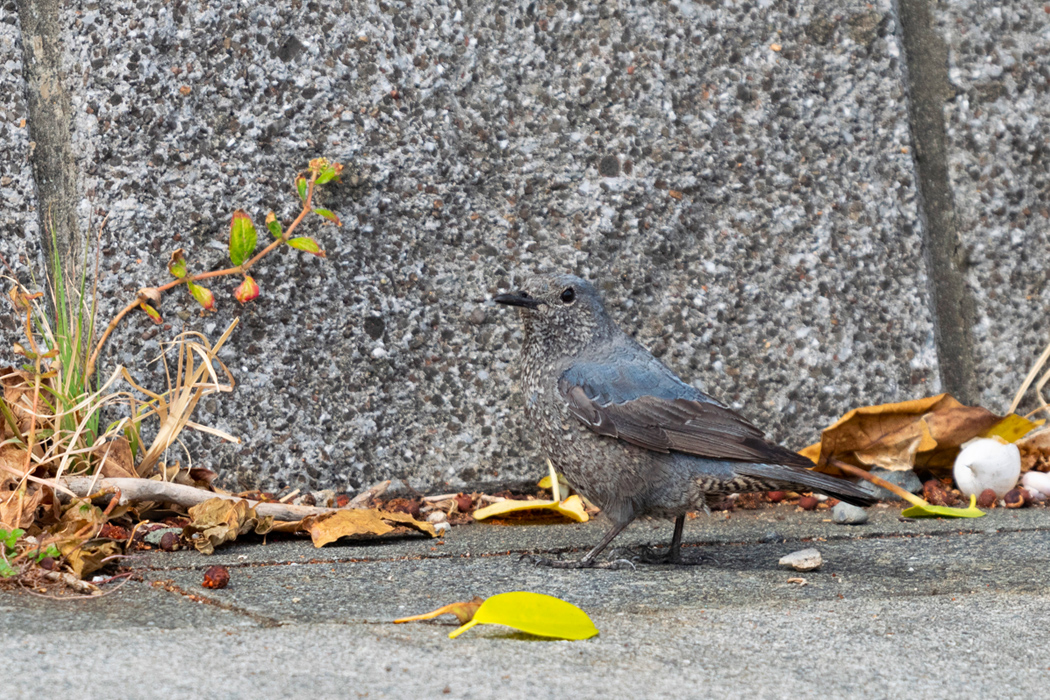
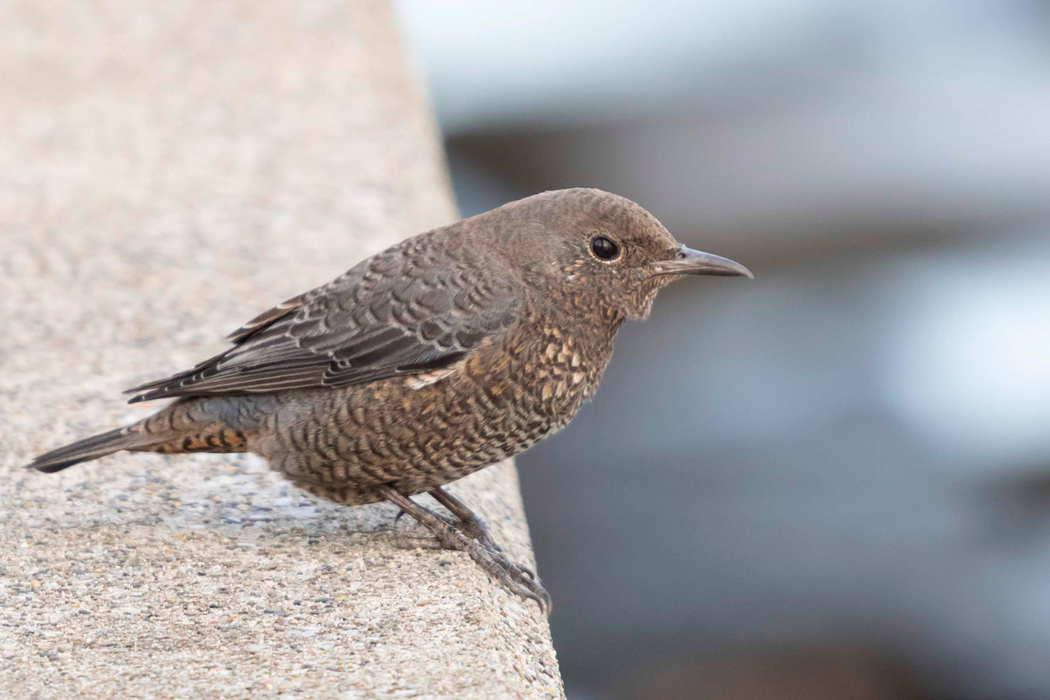
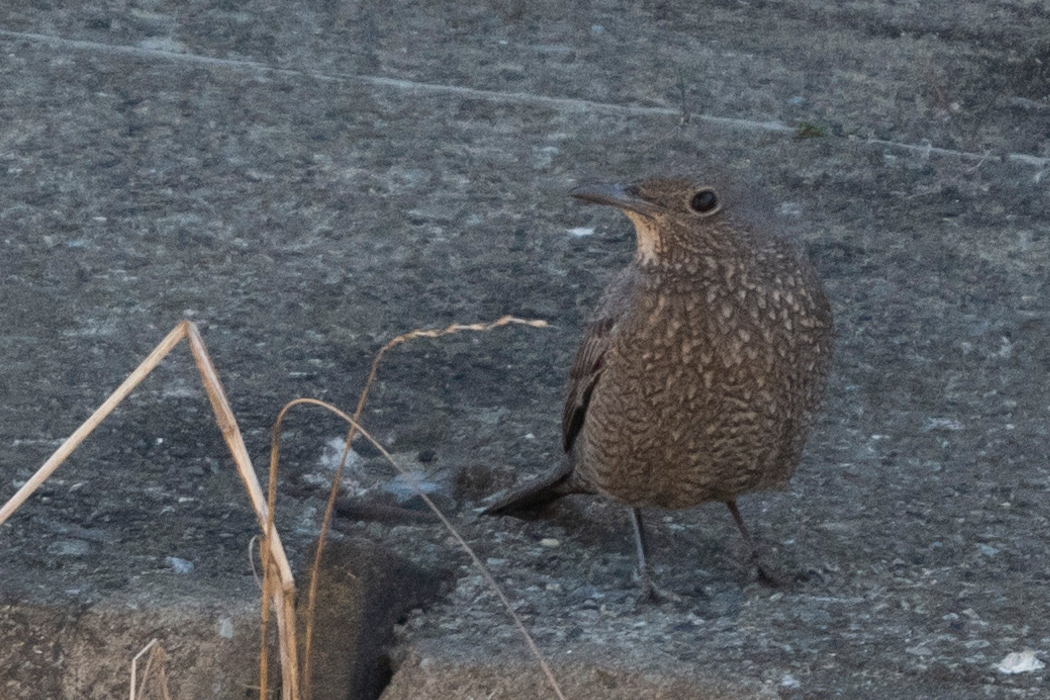
The entire body is black to gray with scaly feathers, resembling a rock surface.
The entire head is grayish-brown. The back has fewer patterns.
Like the male, the wings become closer to black toward the tips.
At first glance, she appears gray and resembles a Brown-eared Bulbul, but the Bulbul is one size smaller. Also, she gives the impression of being on the ground more often than on branches.
Juvenile
Generally mouse-gray and plain. Immature males have a color between gray and blue.
Song
The song is a complex melody described as "pi-tsutsu-pi-pi" or "pyuru-pyuru-pipi-po." The tone is beautiful and the volume is loud, making them easy to identify when singing. They give the impression of singing happily on top of buildings or rocks on sunny days. They also emit "jijit" or "jut" sounds when feeling danger or taking flight.
Blue Rock Thrush Ecology
Habitat
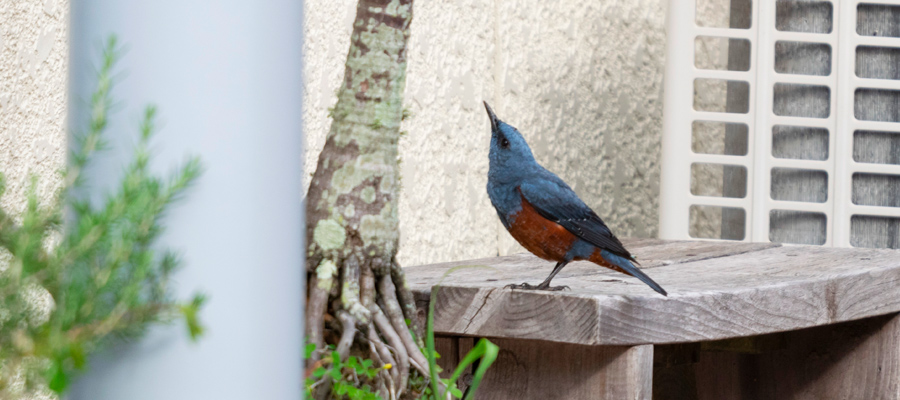
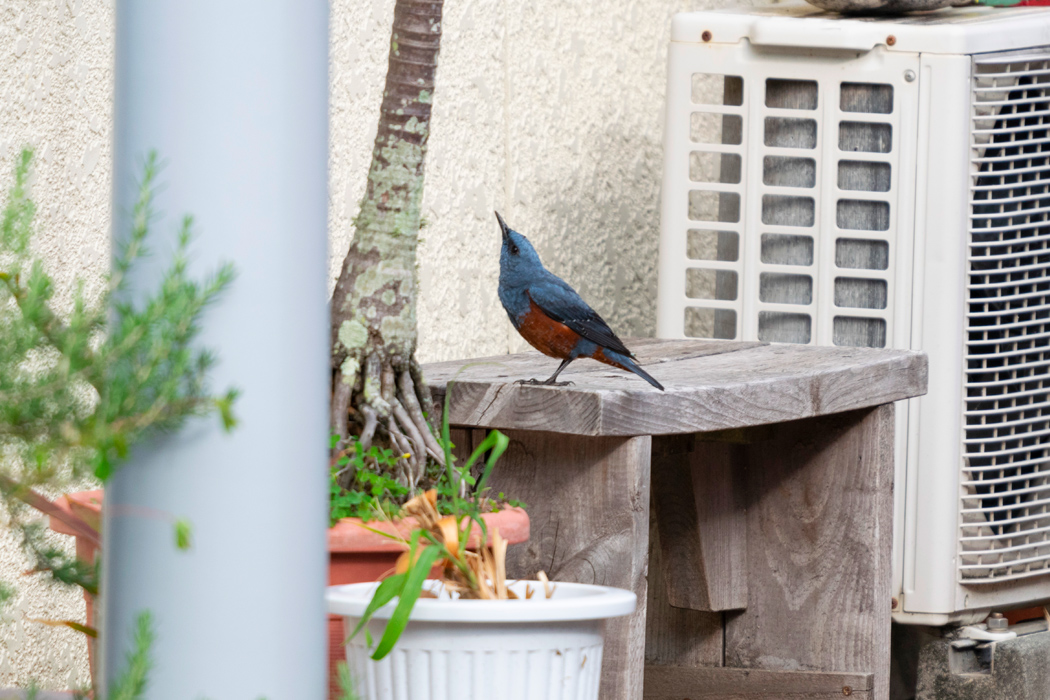
Inhabits coastal cliffs and rocky crevices. In recent years, they have begun nesting on building rooftops in city centers and are also found inland along rivers.
Food
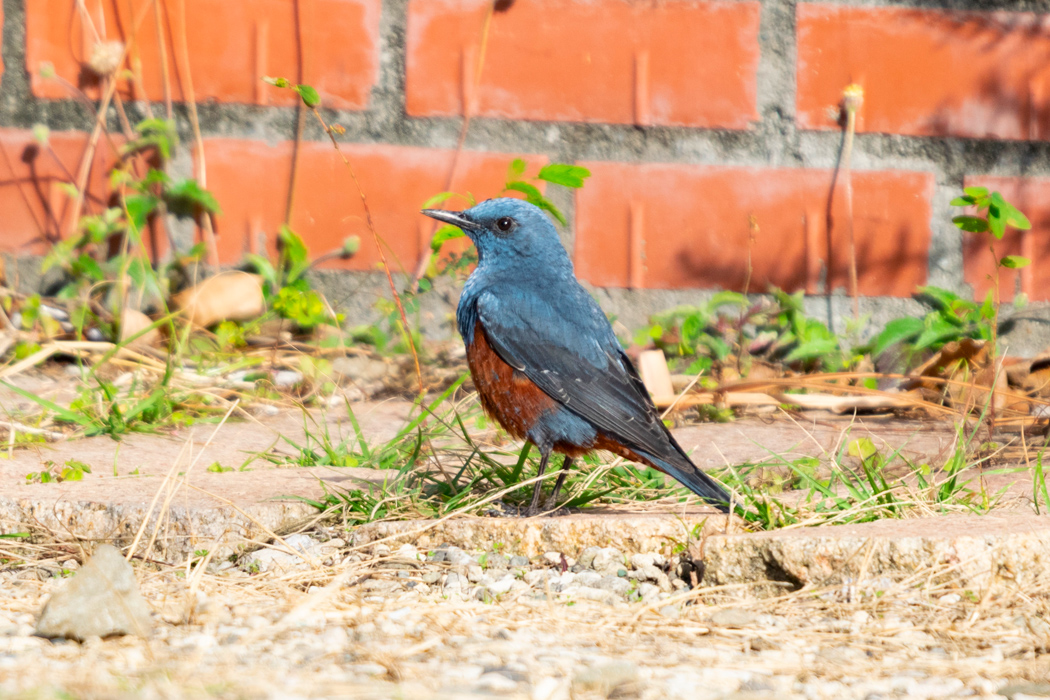
Preys on crustaceans and insects on the ground. While they are often found on tree branches, cliffs, or buildings when singing, they descend to the ground when capturing and eating prey. The Blue Rock Thrushes near my house search for food while walking on concrete blocks along the river.
Life Cycle
They lay eggs in early May, and both parents raise the young. They live solitary lives outside the breeding season. Individuals in northern Japan migrate to warmer regions in winter.
Blue Rock Thrush Photos
Blue Rock Thrush Photos are introduced.
Tap the photo to open the detail page.

Blue Rock Thrush Behavior
On the coast, they stand on the tips of rocks or tetrapods, while in urban areas, they take up positions on high building rooftops or the tops of utility poles to sing. They are also frequently seen walking on the ground searching for food.
Blue Rock Thrush Information
Naming
The scientific name "solitarius" is derived from the Latin word for "solitary" or "alone." The Japanese name, "Iso-hiyodori," literally means "Coastal Bulbul," as they are frequently seen by the sea and resemble the Brown-eared Bulbul. The English name "Blue Rock Thrush" means "a blue thrush that lives in rocky areas," suggesting that in the English-speaking world, they are perceived to resemble thrushes rather than bulbuls.
Friendly Personality
Blue Rock Thrushes seem unbothered even if humans are somewhat close, displaying a friendly nature. They often breed within human living areas, allowing for observation of these vividly colored birds without binoculars, which may contribute to their friendly reputation among people.
Expansion of Distribution Inland
In recent years, their distribution has been expanding inland. I have frequently spotted male and female pairs along the Yudono River in Hachioji City, Tokyo. A survey was reportedly conducted in 2018 as part of the National Bird Breeding Distribution Survey project.
Regarding inland breeding status, studies include research at Sagamiko Station, located 50km from the coast (Tabuchi, 2015), and a study of habitats combining apartments and grasslands in Sanda City, Hyogo Prefecture (Torii & Esaki, 2014). It is suggested that the coastal cliffs where they originally lived resemble artificial environments like apartments in urban areas, and if foraging is easy, there is a high possibility of them settling there. In the near future, they may become a common wild bird even in city centers.
Blue Rock Thrush Found Locations
Chichijima, Ogasawara Islands
Discovered on the coast of Chichijima in the Ogasawara Islands. They were walking and jumping on rooftops and roads. When taking off, they flapped their wings broadly and somewhat slowly as if defying gravity. The females blended in so well with the concrete that it was difficult to notice them from a distance. They were quite friendly and did not flee when humans approached.
Yudono River / Asakawa River, Hachioji City
They can be seen year-round along the Yudono and Asakawa Rivers in Hachioji City, Tokyo. I often hear their singing on concrete blocks along the river or on apartments slightly away from the water. Since they are sometimes under or near bridges, they may be using the undersides of bridges for nesting.
Miura Peninsula
I found a female on a promenade along the coast of the Miura Peninsula. You have a high probability of encountering them when walking along the coast.
Near Katakura Station, Yokohama Line
There was a male near the platform of JR Katakura Station. He was perched on a concrete wall, singing since morning. They are also sometimes seen on top of convenience stores or apartments on the south side of the station.
On a building near Inadazutsumi Station
While walking on the road near Inadazutsumi Station, I heard their characteristic song. Looking closely, I found one on the rooftop of a building near the station.
Blue Rock Thrush Video
Blue Rock Thrush is introduced by video.
A male along the Yudono River in Hachioji City.
A male singing on top of a utility pole.
A female on the riverbank.
References
Picture book
Puffer fish has poison in its internal organs and skin....... Read more
The mottled pattern was likened to a Kyoto woman wearing a kimono....... Read more

eat anchovies on the surface of the sea....... Read more
The Japanese name comes from the squeaking sound of Hiriri....... Read more
From the spread of discharge that makes your buttocks look like it's burning....... Read more
It has a distinctive odor, but it is not poisonous....... Read more