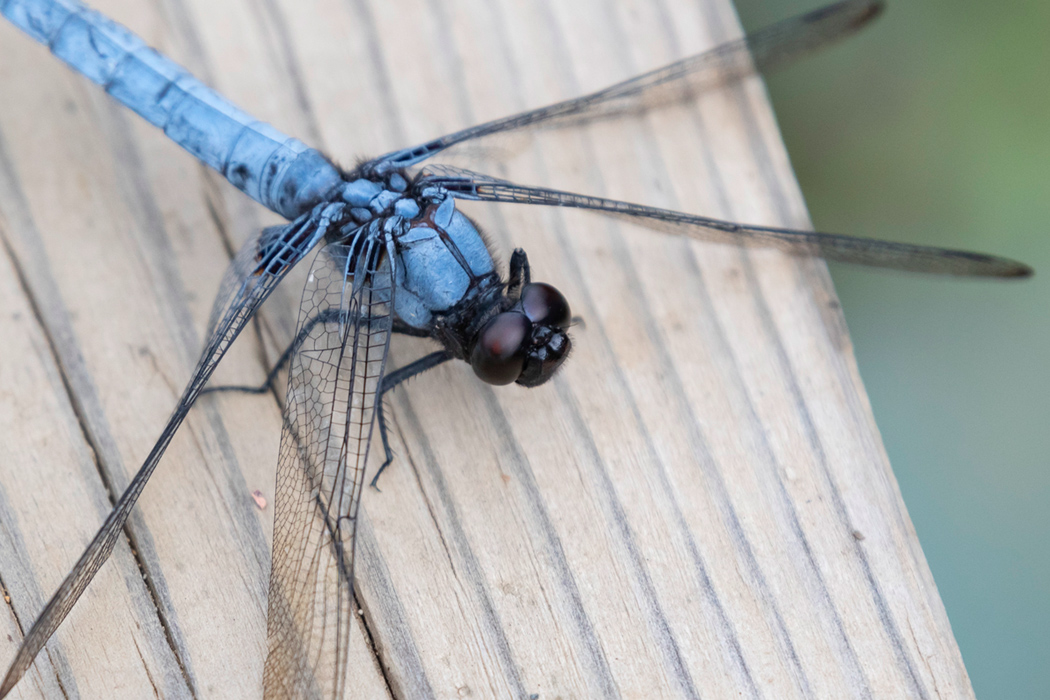
Blue-tailed Forest Hawk
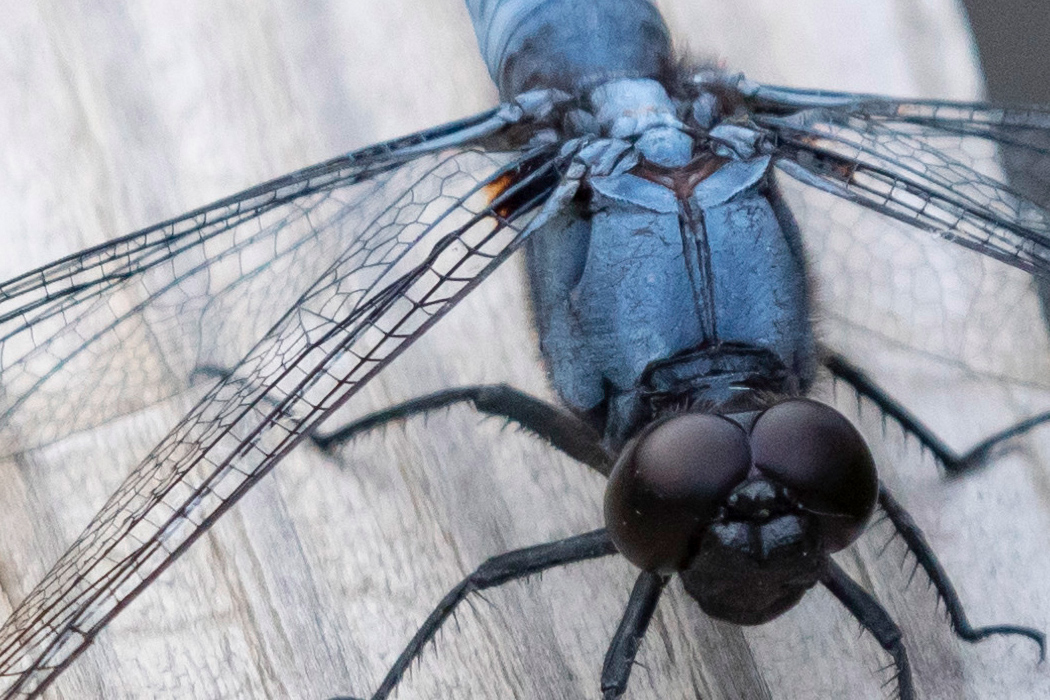
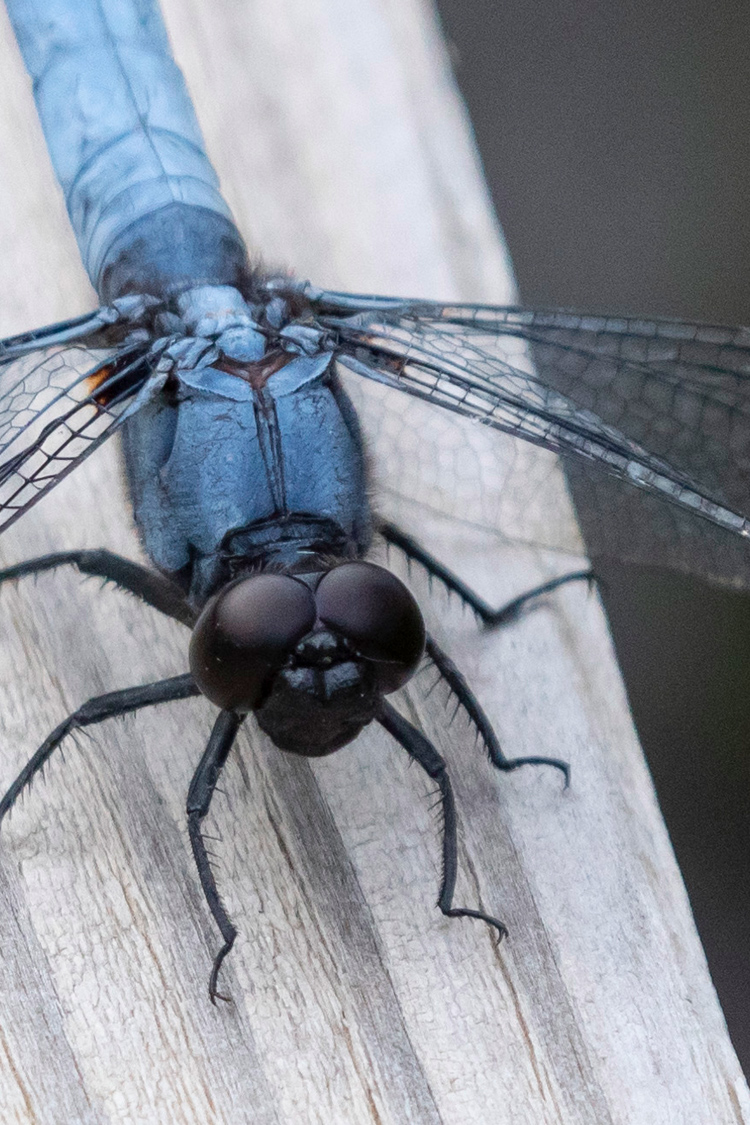
Appears a more vivid light blue than the Orthetrum albistylum (Common Skimmer)
| Scientific name | Orthetrum triangulare melania |
| English name | Blue-tailed Forest Hawk |
| Japanese name | 大塩辛蜻蛉 |
| Class | Insecta |
| Order | Odonata |
| Family | Libellulidae |
| Genus | Orthetrum |
| Species | triangulare |
| Subspecies | melania |
| Full length | 50-60mm |
| Distribution | Throughout Japan |
Blue-tailed Forest Hawk Characteristics and Morphology
A dragonfly that looks like a slightly larger version of the Common Skimmer (Orthetrum albistylum).
Eyes are dark brown.
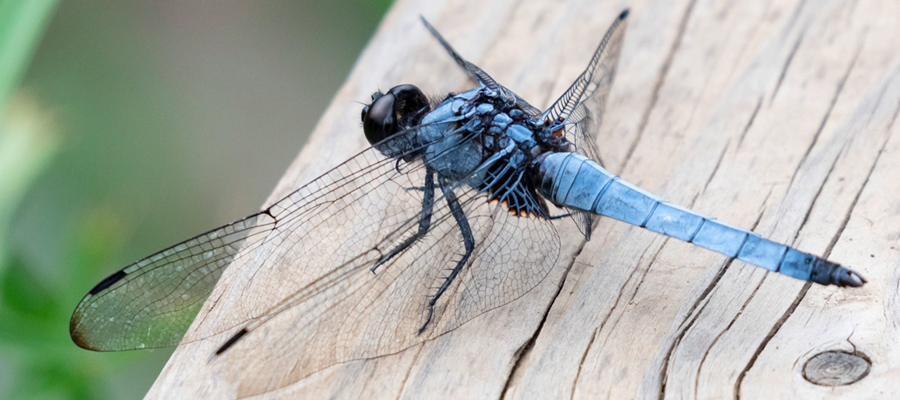
The wings have black veins and black pterostigmata (wing spots) toward the tips. The wing tips are dark brown. The base of the wing has a triangular brown patch, which is the origin of its scientific name.
It is somewhat difficult to identify because it lives in similar places to the Common Skimmer and has very similar coloring. Compared to the Common Skimmer, the thickness of the abdomen remains consistently thick from the base. In the Common Skimmer, the abdomen narrows abruptly right after the base. The black portion at the end of the Common Skimmer's abdomen also appears longer. Since it is hard to distinguish them in flight, it is best to observe them closely when they perch on leaves or the ground.
Male
Overall a light, watery blue. Like the Common Skimmer, the blue area is covered in a white, powdery wax.
Female
Body colors are yellow and black.
The abdomen is yellow up to the middle, while the tip is black.
Blue-tailed Forest Hawk Ecology
Habitat
Distributed throughout Japan. Inhabits watersides at low altitudes. They appear in almost any watery environment, including ponds, marshes, and small streams.
Food
Feeds on small insects.
Life Cycle
They mate on vegetation or similar surfaces. They overwinter in the larval stage.
Blue-tailed Forest Hawk Photos
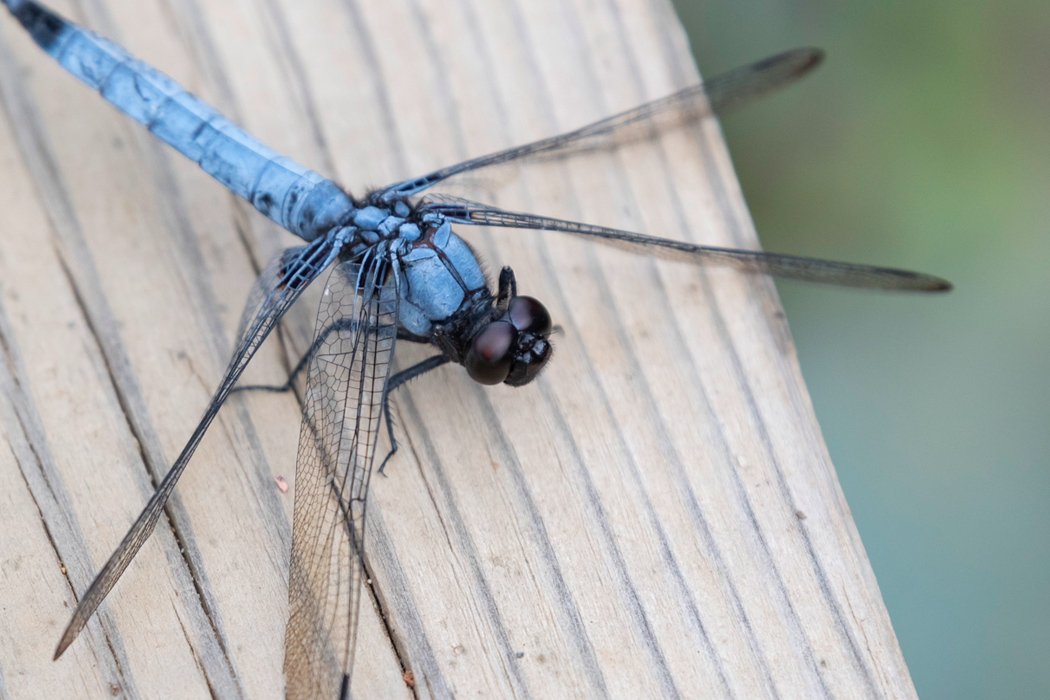
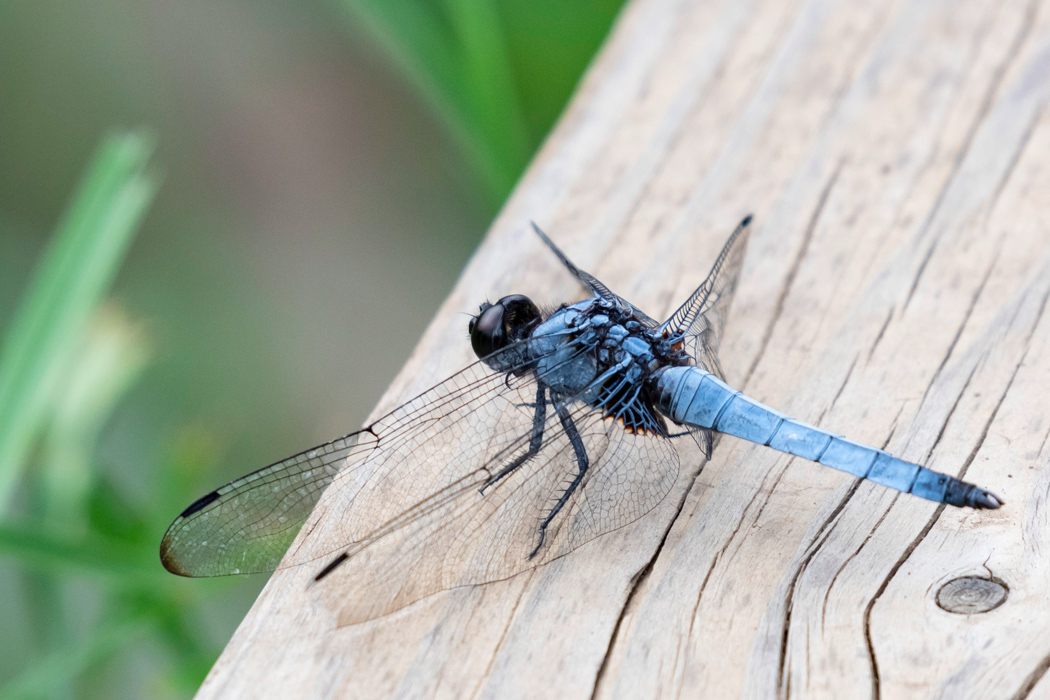
Blue-tailed Forest Hawk Photos are introduced.
Tap the photo to open the detail page.
Blue-tailed Forest Hawk Behavior
If they sense danger while mating, they will fly away while maintaining their coupled position.
Blue-tailed Forest Hawk Information
Naming
The species name "triangulare" means "triangular," referring to the shape of the colored patches at the base of the wings. The subspecies name "melania" means "black," derived from the fact that the populations found in Japan and surrounding areas are darker than the nominate subspecies.
Blue-tailed Forest Hawk Found Locations
Katakura Castle Ruins Park, Hachioji City
Photographed perching on a wooden boardwalk in Katakura Castle Ruins Park. At the time of shooting, I could not distinguish between the Common Skimmer and this species, so I thought they were all Common Skimmers. Two or three males perched about 1m away from me, repeating a movement of retreating slightly as I approached. Excluding the Jumbo Dragonfly (Anotogaster sieboldii), it is among the larger dragonflies in the park, flying around quite leisurely.
Picture book

Japanese endemic species inhabiting mountain streams...... Read more
A grey back paired with a yellow belly....... Read more
A beautiful blue like neon....... Read more
Change body color to mimic....... Read more

small flowers bloom on roadsides....... Read more
small lilac flowers hidden at the edges....... Read more