
Eurasian Wren
Sings with a voice surprisingly loud for its tiny size.
| Scientific name | Troglodytes troglodytes |
| English name | Eurasian Wren |
| Japanese name | 鷦鷯 |
| Class | Aves |
| Order | Passeriformes |
| Family | Troglodytidae |
| Genus | Troglodytes |
| Species | troglodytes |
| Full length | Approx. 11cm |
| Distribution | Distributed across Eurasia, North America, and Northern Africa. In Japan, they are resident birds distributed from the Osumi Islands northward. |
Eurasian Wren Characteristics and Morphology
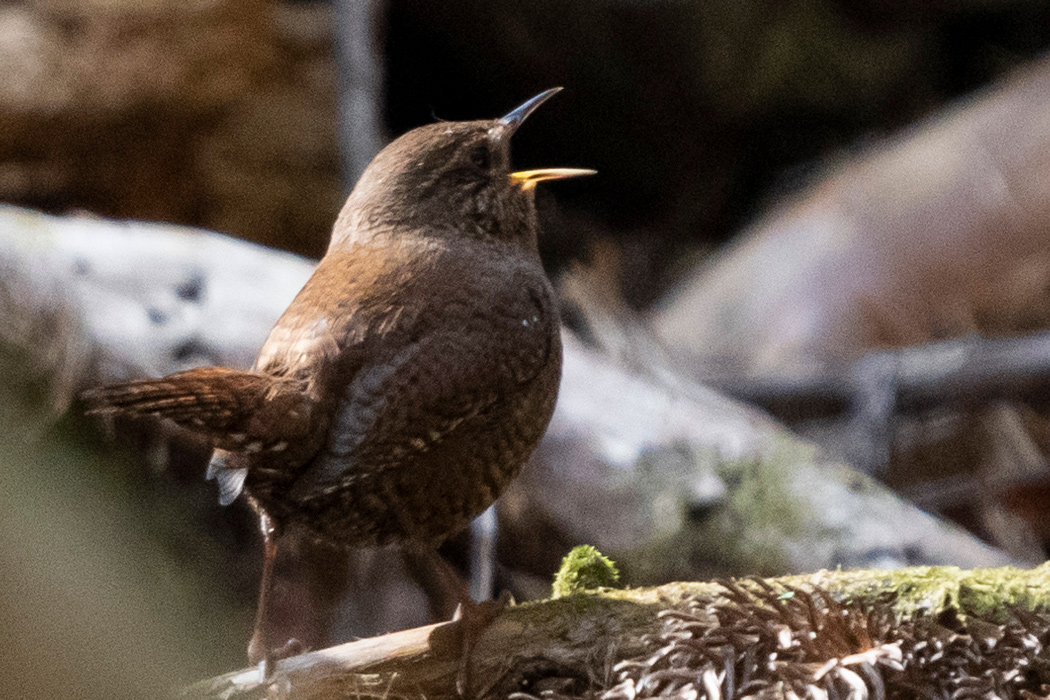
One of the smallest wild birds in Japan. With a total length of only about 11cm, the body alone looks about the size of a golf ball. The entire body is dark brown. Monomorphic (males and females look the same).
The head is small. The inside of the mouth is yellow. A pale brown line runs above the eye.
There are dark brown patterns on the wings.
The tail is short. The legs are brown.
Song
The Wren sings with a beautiful voice so loud it is hard to imagine coming from such a small body. While difficult to transcribe, it is a high, complex, and spirited song that sounds like "churi-churi-chiriririiii." Compared to the Grey Wagtail, which lives in similar environments, the Wren's song is longer and sounds slightly sweeter.

Eurasian Wren Ecology
Habitat
Primarily inhabits mountain streams flowing through forests.
Food
Feeds on insects and other small invertebrates.
Life Cycle
Polygynous; males build several dome-shaped nests using moss at the base of trees to attract females. They breed from spring to summer.
Eurasian Wren Photos
Eurasian Wren Photos are introduced.
Tap the photo to open the detail page.




Eurasian Wren Behavior
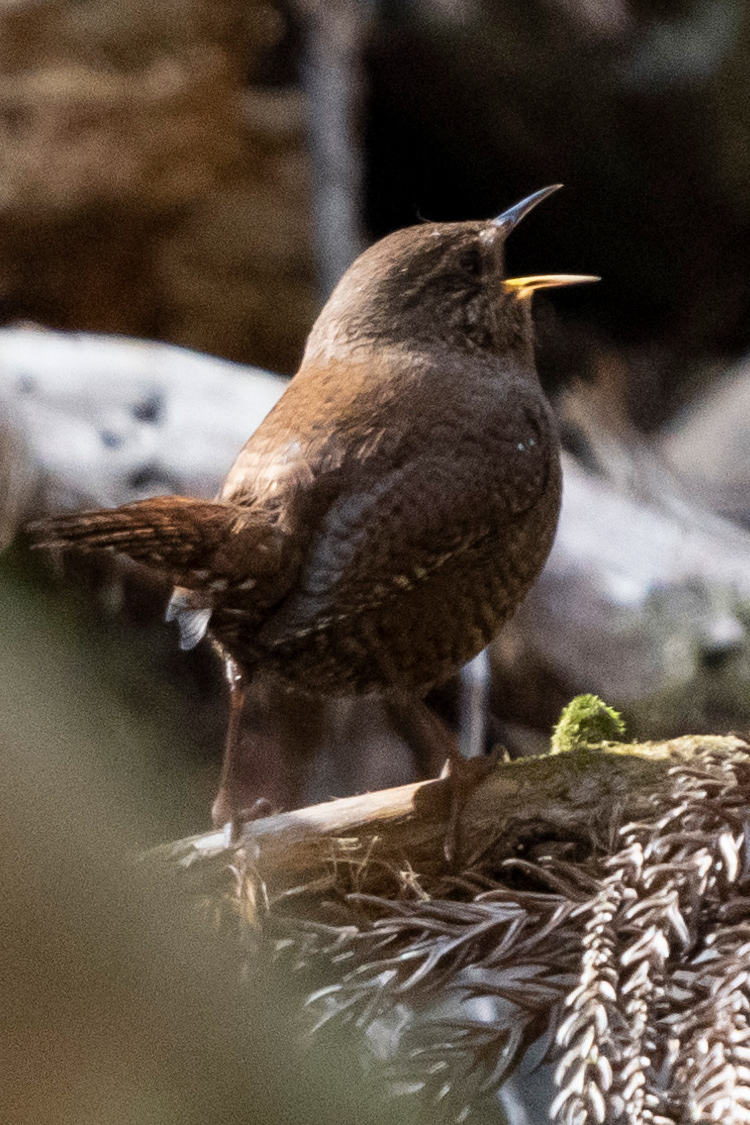
It sings with its short tail cocked upright, vibrating its body while opening its mouth wide. They begin singing around February. They move along streams either alone or in pairs.
Eurasian Wren Information
Naming
The scientific name "Troglodytes" means "cave-dweller," referring to the way the wren enters crevices in rocks or hollows in trees. The unique Japanese name comes from "Sasai" (trivial/minute), signifying its small size.
The Wren is a bird that has been familiar to people around the world since ancient times; in Japan, it appears in the Kojiki and Nihon Shoki. In Europe, it also appears in Grimm's Fairy Tales and various folklores. Despite its small size, it seems to have been loved for its significant presence.
Eurasian Wren Found Locations
Mitakezawa, Akiruno City, Tokyo
I photographed a Wren singing at Mitakezawa in Akiruno City, Tokyo. I heard the voice near the entrance of the mountain trail, and while climbing the path along the stream, I found it perched on a fallen log.
Eurasian Wren Video
Eurasian Wren is introduced by video.
Found near the Hebifuchi Falls.
It was singing.
Picture book

Dark brown body with white eyes....... Read more
Gray body with greenish-black primary feathers....... Read more

Swoop to catch prey....... Read more
A toad found in gardens....... Read more

Also known as "Chinu" in fishing, it is popular....... Read more
The name is derived from its fan-like crest, which once looked like eight separate heads....... Read more